


Makrana Marble for Temple Architecture & Sacred Sculptures
Makrana Marble is a renowned natural stone from Rajasthan used in architectural, monumental and decorative applications. Kundan Shilp evaluates marble selection, finish, detailing and carving requirements for temple architecture, sacred sculptures and traditional stone craftsmanship.
- Material
- Makrana Marble
- Origin
- Makrana, Rajasthan, India
- Material Type
- Natural Calcite-Rich Marble
- Primary Applications
- Temples, Sculptures & Carving
- Suitable Finishes
- Polished, Honed, Traditional Hand Finish
- Typical Uses
- Pillars, Garbhagriha, Domes, Murti Carving
What Is Makrana Marble?
Makrana is a prominent, historically celebrated marble-producing region located in the Nagaur district of Rajasthan, India. Makrana Marble is a natural metamorphic stone with centuries of distinguished use across India’s architectural and monumental heritage, revered in traditional temple building for its purity of tone, crystalline depth, and enduring visual dignity.
Visually, Makrana marble is characterized by an ivory-to-pearly white base tone with subtle, organic grey or bluish-grey linear veining. Because light penetrates slightly into the recrystallized calcite sub-surface before reflecting, the stone exhibits a soft, luminous quality prized in sacred mandapa interiors and sanctum shrines.
Makrana Marble is a registered Geographical Indication (GI) associated with Rajasthan, India, recognizing the unique geological origin and historic craftsmanship of the region. In traditional temple construction, its suitability for intricate carving and load-bearing elements is determined through rigorous project-specific block selection, grain alignment evaluation, and expert Sompura stone masonry.
Geological Characteristics of Makrana Marble
Geologically, Makrana marble is a calcite-rich crystalline metamorphic rock formed through the thermal recrystallization of sedimentary limestone deposits. The tightly interlocked mosaic of calcite grains yields low porosity and remarkable resistance to moisture absorption when properly finished.
Zero Artificial Resin
Naturally consolidated crystalline structure requires no chemical resin backing or synthetic epoxies.
Low Thermal Conductivity
Maintains a temperate, cool contact surface under sunlight, comforting barefoot temple pilgrims.

Makrana marble architectural detailing in traditional Hindu temple design executed with authentic Sompura craftsmanship.
Makrana Marble, Shilpa Shastra & Temple Craftsmanship
In traditional Indian temple architecture, stone selection is intimately governed by scriptural treatises such as the Aparajitaprccha, Mayamata, and Brihat Samhita. Classical canons examine stone along visual quality (Varna), structural soundness, acoustic resonance (Dhvani), and grain continuity.
Traditional Proportions & Hierarchy
Under Shilpa Shastra temple architecture, white marble is traditionally reserved for spaces demanding serene visual purity. Talamana modular dimensions dictate the scaling of marble sanctum surrounds, pillar thicknesses, and deity altars to achieve spiritual dignity and architectural equilibrium.
Ritual Suitability & Surface Quality
Temple sanctums host daily sacred rituals including abhishekams with milk, honey, gangajal, and natural oils. Calcite-rich Makrana marble with fine, tightly bound crystalline grains offers a smooth, dense contact surface that resists deep fluid staining when maintained through traditional cleaning practices.
Sompura Chisel Response
Under a master artisan's claw and point chisels in temple stone carving, sound Makrana blocks allow intricate undercut relief work without brittle micro-fractures. This allows hereditary sculptors to manifest fine facial expressions (Bhavas), ornate jewelry, and filigreed ceiling rosettes.
Makrana Marble Applications in Temple Architecture
Due to its refined appearance and historical prestige, Makrana marble is strategically specified across primary functional, ceremonial, and decorative elements in Hindu and Jain temple projects.
Garbhagriha & Pitha
Why considered: The inner sanctum requires absolute visual serenity and dignified material purity for the sacred pedestal and surrounding wall lining.
Craftsmanship: Precise jointing with hairline mortar margins ensures a seamless, moisture-resistant sacred chamber.
Mandapa Pillars
Why considered: Monolithic marble pillars provide exceptional structural load capacity while allowing elaborate fluting, floral capitals, and bracket figures.
Craftsmanship: Requires verified monolithic blocks tested for structural continuity before lathe shaping and manual detailing.
Temple Ceilings & Jali
Why considered: Consecrated Vitana ceiling mandalas and perforated jali screens filter natural light with dramatic, sacred translucency.
Craftsmanship: High-precision piercing and corbeled bracket interlocking engineered to manage ceiling panel loads safely.
Parikrama Flooring
Why considered: Offers high abrasion resistance against barefoot devotional circumambulation and natural cooling properties in warm climates.
Craftsmanship: Honed or traditional emery-buffed finishes prevent slip hazards while preserving natural stone breathability.
Deity & Sacred Sculptures
Why considered: Fine-grained white marble holds crisp chisel lines, polished contours, and the delicate facial symmetry required by Agamic Dhyana shlokas.
Craftsmanship: Executed by generational Sompura sculptors trained in traditional iconometric Talamana proportions.
Architectural Ornamentation
Why considered: Monumental entrance toranas, carved cornices, narrative friezes, and niche surrounds (Koshthas) achieve timeless classical grandeur.
Craftsmanship: Deeply undercut foliate scrollwork and multi-tiered moldings assembled with traditional dry-interlocking joints.
How We Select Makrana Marble for Temple Projects
Selecting stone for sacred architecture requires a disciplined protocol connecting architectural specifications with quarry realities. Kundan Shilp implements a 5-step selection process for every temple commission.
Project Requirement
Understanding temple architectural style, geographical location, atmospheric conditions, and intended structural or sculptural applications.
Stone Selection
Assessing available marble blocks directly at extraction ranges in Makrana based on size, block homogeneity, and application suitability.
Visual & Technical Review
Reviewing colour harmony, grain orientation, absence of blind cracks, natural veining consistency, and dimensional tolerances.
Carving Planning
Coordinating selected stone blocks with artisan carving complexity, architectural templates, joinery details, and surface finishes.
Final Application
Coordinating fabricated components with on-site assembly, mortarless dry interlocking, and final traditional surface buffing.
Makrana Marble Quality Selection & Inspection
Not every block extracted from Makrana quarries is appropriate for monumental temple architecture. Kundan Shilp’s project-based marble selection process evaluates individual blocks against strict architectural criteria before carving commences:
- Colour Consistency & Veining: Evaluating natural grain direction and veining harmony to ensure visual continuity across large colonnades and wall planes.
- Fissure & Inclusion Audit: Identifying and rejecting blocks containing soft clay pockets, open cracks, or high-iron mineral bands that could pit over time.
- Dimensional & Edge Integrity: Verifying block squareness, depth, and thickness to ensure full compliance with structural architectural drawings.
- Diamond Wire Sawing: Requiring blocks extracted via non-explosive diamond wire sawing to protect the natural crystalline matrix from microscopic shock shattering.
Common Regional Makrana Varieties
Makrana Marble vs Other Marble Options for Temple Projects
The appropriate marble depends on the temple's design, application, carving requirements, location, availability and project budget. Below is an objective overview comparing Makrana marble with other common architectural marbles.
| Parameter | Makrana Marble | Ambaji Marble (Gujarat) | Imported Italian / Carrara |
|---|---|---|---|
| Visual Character | Luminous crystalline white with soft grey veining | Creamy white to ivory with fine cloudy pattern | Cool white to greyish-blue with dramatic veining |
| Carving Response | Resilient under chisel, exceptional edge definition | Soft, fluid grain ideal for deep undercut ceiling rosettes | Brittle under traditional hand chiseling; machine-dependent |
| Resin Requirement | Zero resin backing; 100% natural crystalline stone | Generally unresined for temple grades | Commonly net-backed and resin-treated for slab integrity |
| Ritual Suitability | Traditional gold standard for sanctums and abhishekams | Highly suitable for ornate mandapa domes and Jalis | Not recommended for sacred ritual abhishekams |
| Availability & Budget | Premium investment; limited quarry yields | Moderate-to-premium investment; reliable supply | Widely available commercially; variable pricing |
When Is Makrana Marble Suitable for a Temple Project?
A successful temple balances devotional intent, atmospheric conditions, architectural heritage, and financial stewardship across every building material.
When Makrana Marble Is Highly Suitable
- ✓ Projects requiring classical white marble architectural aesthetics.
- ✓ Sacred Garbhagriha sanctums and deity pedestals undergoing regular abhishekams.
- ✓ Ornate Mandapa pillars requiring intricate hand carving and high load stability.
- ✓ Devotional shrines where a renowned Rajasthan stone heritage is specified.
- ✓ Projects where long-term material dignity takes precedence over lower initial material costs.
When Alternative Stones May Be Considered
| Application | Consider Stone | Architectural Rationale |
|---|---|---|
| Monumental Nagara Shikharas | Bansi Paharpur Pink Sandstone | Weather-resilient monumental spires |
| Intricate Ceiling Domes | Ambaji Marble | Fluid chisel response in deep undercut rosettes |
| Heavy Plinth Foundations | Dhrangadhra Sandstone | Robust foundation load distribution |
| Budget-Optimized Applications | Kumari Marble | Cost-effective parikrama walkways |
Choosing the Right Marble for Different Temple Elements
Every architectural component of a Hindu temple has distinct mechanical, aesthetic, and ceremonial demands. Here is how marble selection should be evaluated across temple zones:
| Temple Element | Selection & Application Considerations |
|---|---|
| Garbhagriha (Sanctum) | Select homogeneous white marble blocks with zero open veins. Requires honed or soft-polished surface to withstand daily panchamrita abhishekams. |
| Mandapa Pillars | Verify monolithic structural integrity and acoustic continuity (Dhvani test). Requires precise dimensional tolerances to carry corbeled beam loads. |
| Jali (Lattice Screens) | Evaluate tensile resilience and uniform crystalline density to avoid fracturing during geometric perforation and hand undercut chiseling. |
| Parikrama Flooring | Opt for dense Dungri or Kumari grades. Apply non-slip honed or matte finish to ensure pilgrim safety and resist heavy footfall abrasion. |
| Deity Sculptures (Murti) | Pure white Makrana stone selected for fine grain consistency, absence of inclusions, and adherence to canonical Talamana iconometric proportions. |
| Ceiling Domes (Vitanas) | Weight-optimized concentric rings carved in interlocking sections, engineered with interlocking joints to distribute load to perimeter pillars. |
Makrana Marble Expertise for Traditional Temple Projects
Founded in 1927, Kundan Shilp represents four generations of hereditary Sompura temple architects. Our team bridges classical Sanskrit canons with physical stone carving, quarry selection, and complete temple construction.
We do not simply supply raw stone; we provide comprehensive architectural stewardship: from quarry block inspection in Rajasthan, through 3D CAD modeling and artisan carving at our dedicated ateliers, to final on-site dry-interlocking erection.

Carved Mandapa & Shikharas
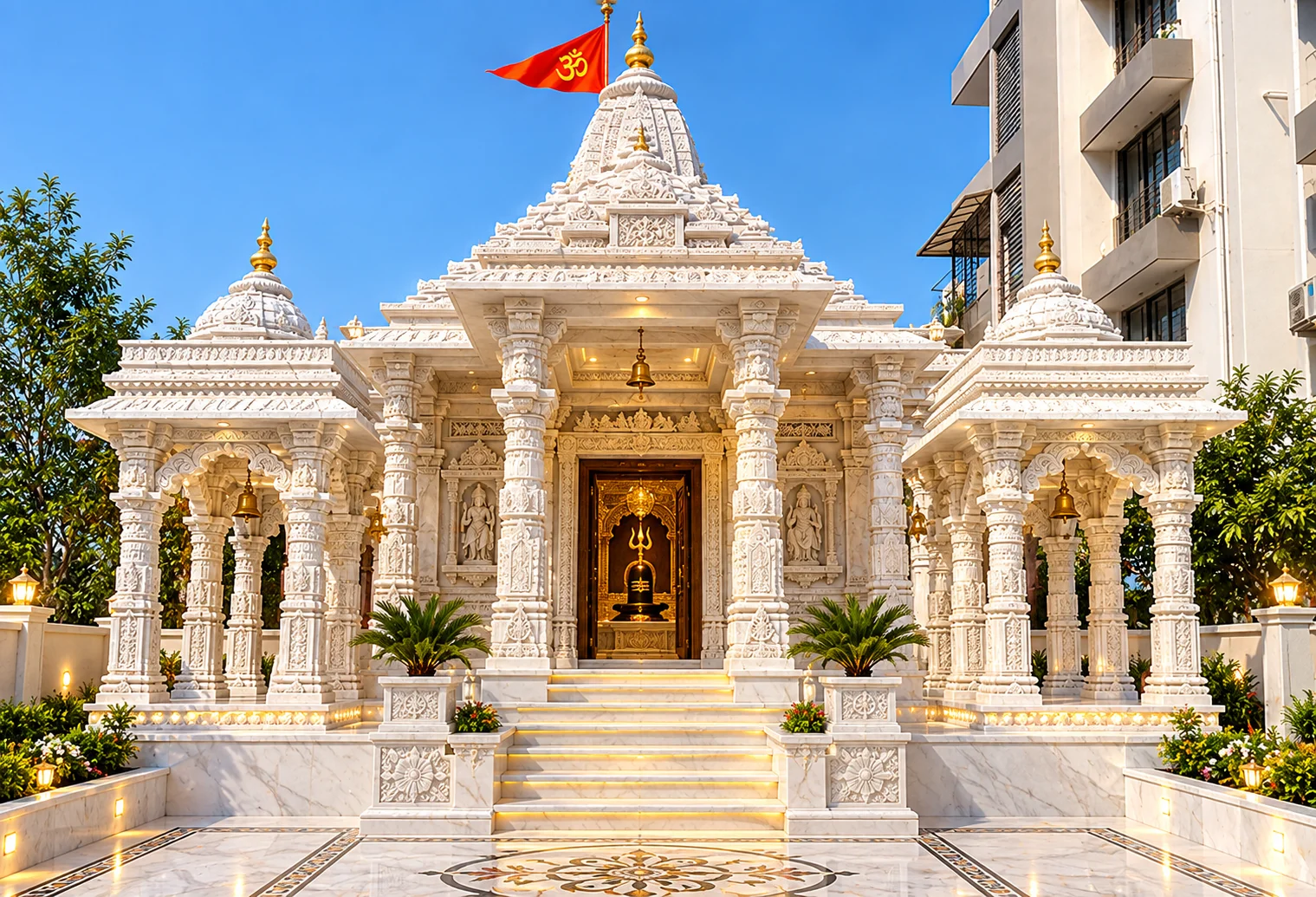
Marble Sanctum & Portal

Concentric Vitana Dome
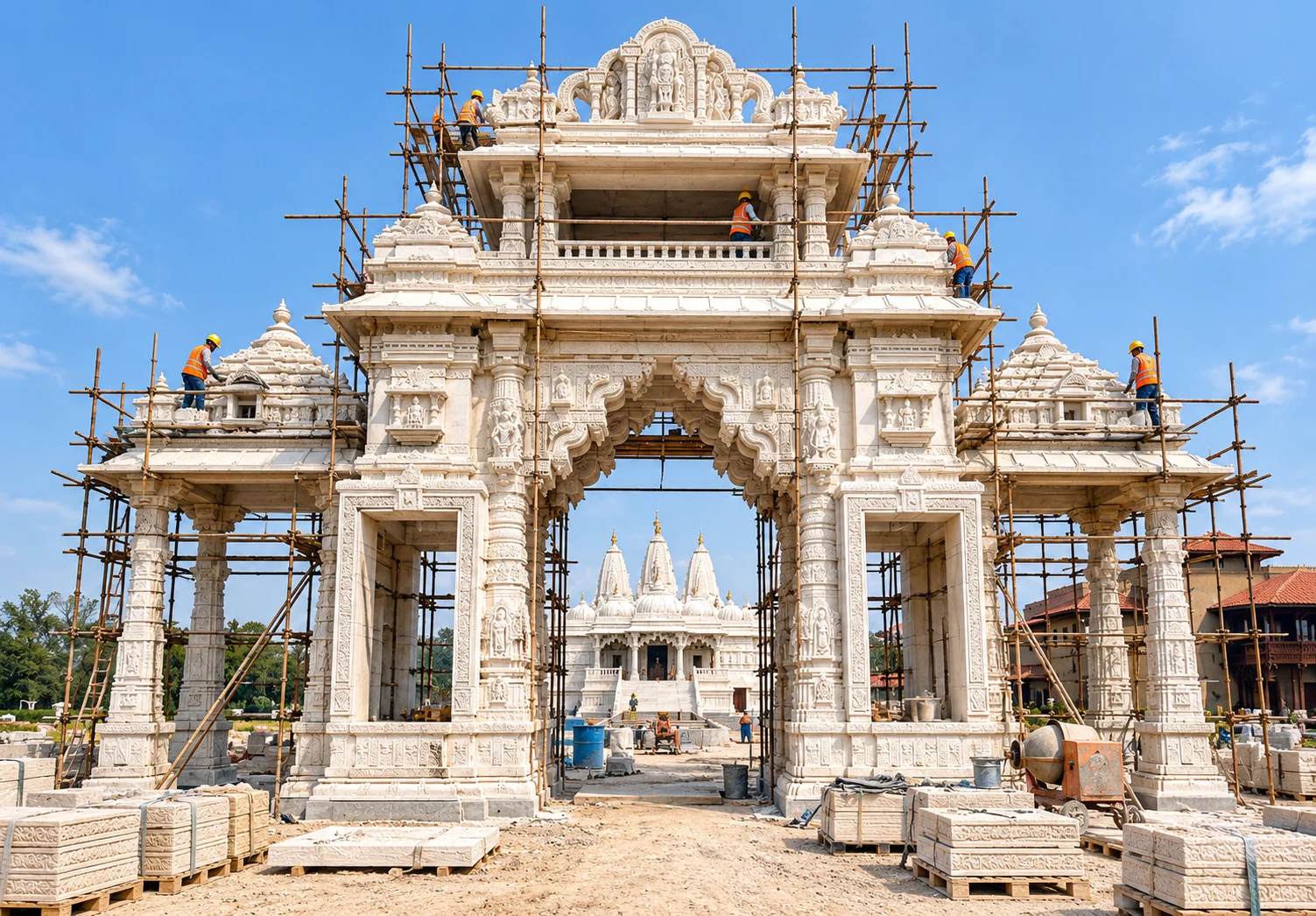
Carved Marble Torana
Makrana Marble Temple Projects & Applications
Real temple projects executed with authentic white marble craftsmanship, canonical proportions, and traditional stone carving.
Swaminarayan Mandir Marble Architecture
Scope: International Hindu temple complex featuring pure white marble carving, ornate shikharas, fluted pillars, and authentic Sompura craftsmanship.
Pure White Marble Sanctum Temple
Scope: Pristine white marble temple structure with carved fluted pillars, lit sanctum steps, and consecrated deity Garbhagriha.
Artisan-Carved Sanctum Ceiling Dome
Scope: Concentric circular marble ceiling dome carved for sanctum interior, showcasing micro-detailed relief work and sacred geometric rosettes.
Frequently Asked Questions About Makrana Marble for Temples
Direct, authoritative guidance on selecting, carving, and maintaining Makrana marble in sacred architecture.
What is Makrana Marble and where does it come from?
Is Makrana Marble suitable for temple architecture?
Why is Makrana Marble used for temple sculptures?
Can Makrana Marble be used for temple pillars and jali work?
Is Makrana Marble suitable for traditional Hindu temples?
How is Makrana Marble selected for temple construction?
How does Makrana Marble compare with other marble options?
Can Kundan Shilp help with Makrana Marble selection for a temple project?
Does Kundan Shilp provide marble temple architecture and stone carving services?
Can Makrana Marble be combined with other temple stones?
Incorporate Makrana Marble Into Your Sacred Temple
Planning a marble temple, sacred sculpture or traditional stone architecture project? Discuss your design, material, carving and construction requirements with Kundan Shilp.
Temple Architecture • Marble Selection • Stone Carving • Construction